• I’ve been thinking about security and how frequent security lapses put all of us on edge. My personal information has appeared multiple times on Have I Been Pawned, and it’s incredibly frustrating especially knowing that many of these breaches happen at billion-dollar companies running multi million-dollar projects with teams of highly skilled professionals working around the clock. Despite having significant resources and expertise, these organizations still experience major data breaches that expose our personal information. Why does this keep happening ?

    Generally, companies don’t rely on a single control or tool for security. Instead, they use a “defense-in-depth model, meaning multiple layers of protection are applied across people, processes, infrastructure, networks, and applications. The goal is that if one layer fails, others still reduce or contain the risk.

    Most mature Companies manage security through a combination of

    • Policies & Governance – security standards, risk management, compliance (ISO 27001, SOC2, HIPAA, PCI-DSS, etc.).
    • Secure SDLC / DevSecOps – security embedded into every stage of development (design  coding  testing  deployment  operations).
    • Security Teams and Roles
    • AppSec engineers
    • Security architects
    • SOC / monitoring teams
    • Red teams / penetration testers
    • Automation & Tooling – scanning, monitoring, logging, incident response systems.
    • Training and Awareness  for developers with secure-coding training, phishing simulations, insider-threat prevention etc.

    We often say security is treated as a continuous lifecycle or moving goal, not a one-time control or activity.

    There are often more than 5 to 10 layers of defense which companies implement in order to ensure that security is not compromised and they are often implemented at

    – Physical and Infrastructure Security

    • Data center security, access controls, CCTV, badges
    • Cloud provider infrastructure controls

    – Network Security

    • Firewalls, VPNs, security groups.
    • Network segmentation / zero-trust networks
    • Intrusion detection & prevention (IDS/IPS)

    – Host / Endpoint Security

    • OS hardening
    • EDR / anti-malware
    • Patch and vulnerability management

    – Application Layer Security

    • Secure coding practices (OWASP Top 10)
    • Static and dynamic code scanning (SAST / DAST)
    • Dependency / supply-chain scanning (SCA)
    • Penetration testing & bug bounty programs

    – Identity & Access Control

    • Authentication and MFA
    • Least-privilege access Role-based access control (RBAC)
    • Secrets and key management

    – Data Security

    • Encryption at rest and in transit
    • Data classification and masking
    • Backup and recovery

    – API and Service Security

    • API gateways and rate limiting
    • mTLS, OAuth, JWT validation
    • Abuse and bot protection

    – Monitoring and Detection

    • SIEM / log monitoring
    • Threat intelligence feeds
    • Behavior analytics & anomaly detection

    – Incident Response and Recovery

    • Playbooks and response plans
    • Forensics and containment
    • Post-incident learning and improvements

    – People and Process Controls

    • Security training & awareness
    • Insider-threat prevention
    • Change management and audits

    In addition to these companies also try to or at least try to mix and adopt DevSecOps and Open Worldwide Application Security Project (OWASP) principles in the development life cycles.

    So even having these many layers of defense’s we still see the security issues. Why is that so ??

    Over time, both agile and traditional software development processes have tended to emphasize features, speed, and delivery timelines over security. In many organizations even those investing millions of dollars and employing large teams security still ends up as a low-priority task addressed late in the project, or in some cases, not addressed at all. Teams often assume that multiple external layers of defense will protect them, reinforcing a mindset rooted in earlier engineering practices where functionality and business value were treated as the primary objectives, while security was viewed as an operational or infrastructure concern to be handled later.

    Product owners and business leaders almost always prioritize customer-visible features and time-to-market because those outcomes directly drive revenue, competitive advantage, and executive performance metrics. Security, on the other hand, is usually viewed as expense rather than a value , especially when the benefits are invisible unless something goes wrong. This creates a trade-off environment where teams feel pressure to ship features quickly, sometimes bypassing security reviews, technical debt cleanup, or risk assessments in order to hit deadlines or launch windows.

    Nearly all modern software is built from many interconnected components, with applications relying heavily on third-party libraries and frameworks to accelerate development and add functionality. However, these dependencies often introduce security vulnerabilities that can cascade into serious risks for the overall system, even if the application code itself is secure. In many organizations, remediation of these vulnerabilities is delayed or deprioritized because teams are under constant timeline pressure, fear that upgrades may introduce regressions, or classify the fixes as “technical debt” to be addressed later. As a result, known security issues can remain unresolved in production for long periods of time, increasing exposure and making dependency management and timely patching a critical yet frequently neglected part of application security.

    Now that we understand, at a high level, how organizations implement security, it’s clear that security cannot exist as a siloed phase in the lifecycle. Instead, it needs to be integrated seamlessly into the SDLC, functioning as a continuous and measurable quality attribute throughout the development process. In this context, DevSecOps provides a strong foundation, as it embeds security practices directly into development and operations rather than treating them as an afterthought. Some of the ways we can integrate security into SDLC is via

    Integrating Security into SDLC Process

    SDLC PhaseSecurity Activity (OWASP Alignment)Outcome/Artifact
    RequirementsDefine security requirements and non-functional requirements (e.g., must support MFA, must protect PII).Security Requirements Document
    DesignThreat Modeling (focused on Insecure Design). Review architecture against OWASP principles (e.g., Least Privilege).Threat Model Report/Data Flow Diagram
    DevelopmentUse secure coding practices, integrated SAST/SCA in IDE, use OWASP Cheat Sheets.Secure Code & Clean SAST/SCA Scan
    Testing/QADynamic Application Security Testing (DAST) and Penetration Testing (check for OWASP Top 10 risks).Security Test Report/Pentest Findings
    DeploymentSecure Configuration Management (Security Misconfiguration) and continuous security monitoring.Hardened Environment/Configuration Baseline

    Embedding in Agile/Scrum Planning

    • Security Stories in Backlog: Create security user stories or Security Epics that address specific risks or OWASP risks (e.g., “As a user, I should not be able to bypass access controls to view another user’s account details.”). This ensures security work is prioritized and tracked.
    • Sprint Planning:- Dedicate a portion of every sprint to security, often as a spike for threat modeling a new feature or as a task to remediate high-priority security defects from automated scans.
    • Definition of Done (DoD):- Security must be part of the DoD. Feature is not complete until it passes the security checks, which should include “Feature has been threat modeled,” and “Secure code review completed.”
    • Retrospectives:- Review security incidents or near-misses during the sprint retrospective to identify root causes and improve the secure development process continuously.
    • Every sprint should proactively review whether any dependencies contain security-related vulnerabilities and plan remediation work as part of the sprint, rather than deferring everything into a single large ticket later. Integrating dependency risk assessment into the regular sprint cycle ensures that vulnerabilities are addressed incrementally and consistently, instead of accumulating as unmanaged technical debt.

    So, the next time we run into a security issue, instead of simply logging it as another task, what if we pause and ask our product and technology leaders a deeper and meaningful question

    Is this just a backlog item or that our approach to security needs to change ?

    With hope that this question might spark a much more meaningful conversation about risk, priorities, and how seriously we treat security in the lifecycle.

    I believe the very definition of security will evolve in the era of AI, and the way we approach it will fundamentally change. As AI becomes more advanced and fully mainstream, a significant portion of our work will shift toward identifying, managing, and mitigating AI-driven threats. We’ll increasingly face challenges such as deepfakes, AI-generated voice agents, and synthetic videos that convincingly mimic real users and legitimate interactions. In this future, security won’t just be about protecting systems or data it will also be about protecting identity, authenticity, and trust in a world where what we see and hear can no longer be taken at face value.

  • Machine Learning (ML) system is an integrated computing environment composed of three fundamental components:

    • Data that guides algorithmic behavior,
    • Learning algorithms that extract patterns from this data, and
    • Computing infrastructure that enables both the learning process (training) and the application of learned knowledge (inference or serving).

    Together, these components form a dynamic ecosystem capable of making predictions, generating content, or taking autonomous actions based on learned patterns. Unlike traditional software systems, which rely on explicitly programmed logic, ML systems derive behavior from data and adapt over time through iterative learning processes. Understanding their architecture and interdependencies is essential to designing, operating, and maintaining reliable AI driven applications.

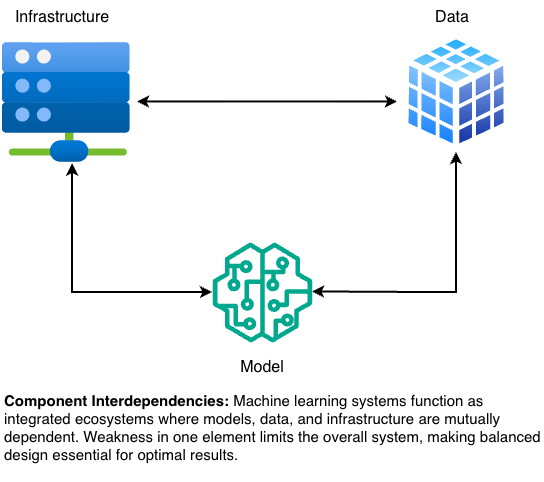
    At the core of every ML system lies a triangular dependency among Models/Algorithms, Data, and Computing Infrastructure framework often referred to as the AI Triangle. Each of these components plays a distinct role while simultaneously shaping and constraining the others.

    • Algorithms (Models) :- Mathematical frameworks and optimization methods that learn patterns or relationships within data to make predictions, classifications, or decisions.
    • Data:- The lifeblood of ML systems comprising the processes, storage mechanisms, and management tools for collecting, cleaning, transforming, and serving information for both training and inference.
    • Computing Infrastructure:- The hardware and software stack that powers the training, deployment, and operation of machine learning models at scale. This includes GPUs/TPUs, distributed computing clusters, data pipelines, and orchestration frameworks.

    These three elements interact in a feedback loop. The model architecture determines computational requirements (such as GPU memory or parallel processing) and influences how much and what kind of data is necessary for effective learning. The volume, quality, and complexity of available data, in turn, constrain which model architectures can be effectively trained. Finally, the capabilities of the computing infrastructure its storage, networking, and compute capacity set practical limits on both the data scale and model complexity that can be supported.

    In essence, no component operates in isolation. Algorithms require data and compute power to learn and large datasets need algorithms and infrastructure to extract value and infrastructure serves no purpose without the models and data it is designed to support. Effective system design thus requires balancing these interdependencies to achieve optimal performance, cost efficiency, and operational feasibility.

    While both ML systems and traditional software rely on code and computation, their failure modes differ fundamentally. Traditional software follows deterministic logic when a bug occurs, the program crashes, error messages appear, and monitoring systems raise alerts. Failures are explicit and observable. Developers can pinpoint the root cause, fix the defect, and redeploy the corrected version.

    Machine learning systems, however, exhibit implicit and often invisible degradation. ML system can continue to operate serving predictions and producing outputs while its underlying performance silently deteriorates. The algorithms keep running, and the infrastructure remains functional, yet the system’s predictive accuracy or contextual relevance declines. Because there are no explicit errors, standard software monitoring tools fail to detect the problem.

    This distinction highlights why ML engineering requires a new class of observability and monitoring frameworks focused on data quality, model drift, and performance metrics rather than system uptime or error logs. ML systems demand continuous evaluation and retraining to maintain alignment with real-world conditions.

    Autonomous vehicle’s perception system vividly illustrates this contrast. In traditional automotive software, the engine control unit either manages fuel injection correctly or raises diagnostic warnings. Failures are binary and immediately observable.

    In contrast, an ML based perception model may experience gradual, unobserved performance decline. Suppose the model detects pedestrians with 95% accuracy during its initial deployment. Over time, as environmental conditions change seasonal lighting variations, new clothing styles, or weather patterns underrepresented in the training data the detection accuracy may drop to 85%. The vehicle continues to operate, and from the outside, the system appears stable. Yet, the subtle degradation introduces growing safety risks that remain invisible to conventional logging systems.

    This silent failure mode where the system remains functional but less reliable is emblematic of ML engineering challenges. Only through systematic data auditing, reevaluation, and retraining can engineers detect and mitigate such degradation before it leads to unacceptable risk.

    The phenomenon of silent degradation affects all three components of the AI Triangle simultaneously:

    • Data Drift:- Over time, real world data distributions change. User behavior evolves, new edge cases emerge, and external factors such as seasonality or market shifts alter input patterns. The training data, once representative, becomes outdated.
    • Algorithmic Staleness:- Models trained on past data continue to make predictions as if the world hasn’t changed. Their learned parameters no longer reflect current realities, leading to diminishing accuracy and relevance.
    • Infrastructure Reinforcement:- The computing infrastructure, built for reliability and throughput, continues serving predictions flawlessly even as those predictions grow increasingly inaccurate. High uptime and low latency metrics mask the underlying problem, amplifying the scale of degraded decision-making.

    Practical example for this behavior is e-commerce recommendation system. Initially achieving 85% accuracy in predicting user preferences, it may drop to 60% within months as customer tastes evolve and new products enter the catalog. Despite this decline, the system continues generating recommendations, users still see suggestions, and operational metrics report 100% uptime. However, the system’s business value silently erodes classic case of training serving skew, where the distribution of data during training diverges from that during real-world inference.

    The insights of Richard Sutton, a pioneer in artificial intelligence and reinforcement learning, shed light on why these dynamics persist. Sutton’s research, including his co-authored textbook Reinforcement Learning: An Introduction, fundamentally shaped how machines learn from trial-and-error mirroring how humans acquire skills through experience.

    In 2024, Sutton and Andrew Barto received the ACM Turing Award, computing’s highest honor, for their contributions to adaptive learning systems. Sutton’s influential essay, The Bitter Lesson, distills seven decades of AI research into one powerful observation that general methods that leverage large-scale computation consistently outperform approaches based on manually encoded human expertise.

    This principle explains why modern ML systems, despite their sophistication, remain dependent on vast computational and data resources and why their fragility often stems from overreliance on statistical learning rather than explicit human understanding. Sutton’s perspective underscores the trade-off at the heart of the AI Triangle as systems grow more general and data-driven, they become more capable but also opaquer and more vulnerable to unnoticed performance decay.

    Designing resilient machine learning systems requires acknowledging and managing these interdependencies and failure modes. Successful engineering practices includes

    • Data Monitoring and Validation:- Continuously track input distributions, data quality, and label accuracy. Detect and respond to shifts early using statistical drift detection tools.
    • Model Performance Tracking:- Evaluate model accuracy, precision, recall, and fairness metrics in production using live data. Implement automated retraining pipelines.
    • Infrastructure Observability:- Extend system health monitoring to include model health metrics, not just uptime or latency.
    • Feedback Loops:- Incorporate user feedback and edge case analysis to keep models aligned with evolving conditions.
    • Ethical and Safety Considerations:- Recognize that silent degradation can have real-world consequences especially in healthcare, finance, and autonomous systems.

    The future of ML engineering will depend less on building ever larger models and more on developing self-aware systems that detect and adapt to their own degradation concept sometimes referred to as self-healing AI infrastructure.

    So now we understand as why OpenAI needs government support to fund and expand its operation and it’s due to bitter lesson.

  • With over two decades of experience in technology-driven organizations, I’ve consistently observed that most companies regardless of industry tend to develop multiple layers of management across their business lines. However, in smaller organizations with fewer than 300 employees or less, these layers often flatten. It’s uncommon to see long tenured leaders managing many managers in such settings. Instead, leaders in smaller companies frequently take a hands-on approach writing code, building prototypes, or spending hours alongside junior engineers to solve technical challenges, regardless of the seniority of their title. They often balance both technical and people management responsibilities. In contrast, in large public organizations like major banks or fintech enterprises, the higher one moves in the hierarchy, the less direct interaction they tend to have with employees several levels below. These differences inspired me to reflect on and write about one particular role that embodies this shift the manager of managers.

    Large organization often have multiple levels individual contributors (ICs, engineers, testers, designers), then first‐line managers (engineering managers, team leads) who directly supervise those ICs, and above them, managers of those managers (senior engineering managers, directors, portfolio leads). The manager of managers(MoM) is the role that sits above one or more first‐line managers, and often has responsibility for multiple teams, engineering managers, or product streams.

    Why do we need managers of managers ?

    Here are some of the core reasons:

    Span and Complexity
    As the organization grows, a senior leader cannot directly manage each individual engineer that span becomes too large and becomes ineffective. Manager of managers reduces span of control by delegating direct supervision to first‐line managers. The concept of span of control explains how many direct reports a manager can meaningfully lead.

      Example: Suppose you have 8 teams of 8–12 engineers each (≈ 80–100 engineers). It would be unmanageable for a single manager to meet with each of those 80 engineers weekly and maintain quality coaching. Instead, you have 8 team leads (engineering managers) each managing ~10 engineers, and one senior engineering manager above them coordinating across teams, aligning strategy, budgeting, resource allocation, and so on.

      Strategy to execution alignment
      The manager of managers links strategic goals (from senior leadership) to the execution of multiple teams. They translate higher-level objectives into team-level targets, ensure cross-team coordination, manage dependencies, remove impediments that span team boundaries, and allocate resources between teams. They serve as a bridge between tactical work (by the teams) and macro-organizational objectives.

      Example: The company decides to improve latency of a core service by 50 %. Teams A and B are responsible respectively for frontend and backend. The manager of managers works with both engineering managers to ensure their plans align, dependencies are identified (e.g., data model changes), and that the execution schedules sync.

      Consistency, standardization, process, and culture
      As you scale engineering, you need standard engineering practices, consistent processes (e.g., code reviews, CI/CD pipelines, deployment standards, quality metrics), architectural coherence, and a shared culture. This is often beyond the purview of a single team lead and requires oversight at the managerial layer above. Manager of managers ensures there is a coherent engineering function rather than dozens of siloed teams doing their own thing.

      Developing managers and leadership pipeline
      The manager of managers plays a key role in developing the engineering managers coaching them, helping them grow, providing leadership development, helping them build the right kind of team culture, helping them manage up and down. Without that layer, managers may end up isolated or repeating mistakes.

      • Handling cross‐team issues and scaling blockers
        Many blockers in larger engineering orgs are cross‐team architectural decisions, platform choices, shared services, infrastructure, operations, organizational dynamics, budgeting, priority conflicts, resource tradeoffs, etc. Manager of managers is positioned to handle these broader issues. They can elevate issues to senior leadership or work across peers to resolve them.

      Problems they solve :-

      • Overload of individual contributor management: If a senior leader tried to manage all engineers directly, they’d be overwhelmed with 1:1s, escalations, personal development, performance reviews. The manager of managers alleviates this.
      • Tactical focus misalignment: Without that middle managerial layer, senior leaders risk focusing too much on day-to-day rather than strategic view, and teams may drift in inconsistent directions.
      • Knowledge silos and duplicate efforts: The senior manager of managers helps coordinate across teams, reduce duplication, enforce shared infrastructure, and spread best practices.
      • Poor feedback flows / information bottlenecks: The manager of managers helps propagate information up and down, ensures leadership hears what’s happening on the ground, and ensures the ground hears what leadership expects.
      • Weak leadership development: Without managers of managers, team leads may lack mentorship, miss leadership capability growth, and the organization may struggle to scale People/Leadership maturity.

      Strengths of the manager of managers role

      • Scale of impact: Manager of managers can influence dozens or hundreds of engineers (via the managers) rather than a single team. Their decisions and actions ripple across the org.
      • Broader perspective: They see across teams, understand broader dependencies and systemic issues, and can optimize at the team of teams level.
      • Leadership leverage: Their time is spent more on coaching and leadership rather than purely delivery tasks. they elevate managers, enabling the organization to be stronger overall.
      • Strategic alignment: They can ensure strategic objectives are embedded into team plans and that teams are working toward common goals.
      • Culture steward: They have the ability to influence engineering culture at scale e.g., standardizing practices, improving quality, impacting morale, removing toxic behaviors.

      Weaknesses / potential pitfalls

      • Distance from the work: As you climb up the hierarchy, you get further from the day-to-day work. There is risk of being out of touch with what engineers actually do or feel, leading to decisions that don’t match reality.
      • Information distortion: With multiple layers, information may become filtered or sanitized; the manager of managers may rely heavily on inputs from their direct reports (engineering managers) and may miss what’s really going on.
      • Loss of agility: Having more layers can slow decision-making, increase bureaucracy, and reduce responsiveness. The middle layer may become gatekeeping rather than enabling.
      • Leadership vs. delivery tension: The manager of managers may get pulled into delivery or project tasks instead of maintaining leadership duties, thereby diluting their leverage. They might micromanage managers or teams, undermining them.
      • Over-control or under-visibility: If a manager of managers intervenes too heavily, they risk undermining the autonomy of the engineering managers. If they intervene too little, they risk being invisible and losing influence.
      • Burnout risk: They have to juggle many stakeholders, both upwards (senior leadership) and downwards (engineering managers and teams), while dealing with cross-team issues; the role can be high pressure.

      Example –

      You are Senior Engineering Manager overseeing three engineering managers (A, B, C), each with a team of 10 engineers working on micro-services. The organization’s goal for the quarter is to reduce service outages by 40%. As the manager of managers, your duties include:

      • Working with A/B/C to ensure each team aligns a plan to improve resilience (e.g., automated chaos testing, better monitoring, faster rollback).
      • Reviewing cross-team dependencies (e.g., shared service used by A and  C’s teams) and negotiating resource allocations.
      • Coaching A/B/C on how to lead their teams, manage risk, escalate effectively, build reliability culture.
      • Holding skip‐level meetings (more on that later) with engineers in their teams to sense morale, culture, bottlenecks.
      • Reporting up to the leadership about progress, risk, and resourcing, while translating senior leadership strategy into team-level objectives.

      In doing so, you will ensure that the engineering organization doesn’t devolve into siloed teams but moves together.

      Skip-Level Meetings

      Now let’s dive into the practice of skip-level meetings what they are, why they’re important (especially for managers of managers), how to run them, their benefits, pitfalls, whom to invite, and best practices.

      What are skip-level meetings?

      Skip-level meeting is typically a 1:1 (or small group) meeting between a manager and an employee who reports not to them directly, but via one intermediate managerial layer. For example, a director meets with an individual contributor whose direct manager they supervise. These meetings “skip” the manager in between.

      Skip-level meetings are typically semi-frequent meetings between staff who have a layer in the org‐chart separating them. Skip‐level meeting is a meeting where you, as a manager, meet one‐on‐one with the direct report of a manager who you manage.

      Who needs to hold skip-level meetings ?

      • Managers of managers (senior engineering managers, directors) who want visibility into what their teams are experiencing.
      • Leaders who want to build trust and relationships beyond their direct reports.
      • Organizations that are scaling and need to maintain connection between senior leadership and individual contributors.
      • First-line managers may invite the next level down for broader cross-team discussion, but the core value is when leadership meets leaf nodes of the organization.

      Why do skip-level meetings matter / what problems do they solve ?

      1. Break down the “good-news cocoon” / “ivory tower”
        Senior leaders can become insulated and only hear filtered, positive information. Skip‐level meetings give access to raw, unfiltered feedback from the people who do the work.

      Example: Engineer may have frustration with a process bottleneck that their manager doesn’t raise upward in a skip‐level meeting, the senior manager hears it and can act.

      • Build rapport and trust
        ICs feel seen and valued when senior leaders make time for them. They perceive that leadership cares beyond just the manager.

      Example: Engineer might feel their career progression is only seen by their manager. Skip meeting makes them feel their voice is heard further up.

      • Improve communication and alignment
        Senior leaders can share vision, strategy, and context directly to the people doing the work, reducing misalignment and we don’t know why we’re doing this.

      Example: Senior engineering manager can explain why reliability is a priority this quarter, so engineers in each team understand not just what but why.

      • Detect emerging issues early
        Because you engage people further downstream, you can pick up morale issues, hidden blockers, manager performance problems, cross‐team friction, or other soft signals before they become big issues

      Example: Several engineers mention repeated miscommunication in one team; senior leader hears this and coaches the team lead.

      • Develop leadership visibility and pipeline
        It gives senior leaders insight into up-and-coming talent, and for employees to see leadership beyond their manager (important for their growth).

      Example: Senior manager spots an engineer consistently raising smart suggestions in skip‐level and later sponsors them for a leadership development program.

      How to do skip-level meetings when you are a manager of managers

      Here are the steps and guidelines for doing it :-

      1. Set intention and communicate it
        1. Tell your direct reports (the managers) you plan to hold skip‐level meetings. Frame it as support rather than monitoring them.
        1. Tell the employees you’ll meet with what the purpose is getting to know them, hearing what’s going on, improving collaboration, not undermining their manager.

      Example invite :-

      “Hi Team, I’d like to set up a skip‐level conversation so we can talk about what’s going well, any challenges, and how you’re experiencing the organization. Your manager knows this is happening. I’m looking forward to connecting.”

      • Decide frequency / cadence
        • You can’t meet with everyone very often. For many teams, quarterly or bi-monthly is a reasonable interval.
        • Prioritize based on key teams, high changes, or high-risk groups.

      Example: If you manage 100 engineers including contractors via 10 managers, you might aim to meet every engineer at least once every month, or rotate more often for critical teams.

      • Prepare an agenda, but keep it flexible
        • Have open‐ended questions:- What’s going well ?, What’s getting in your way ?, What questions do you have for me or the organization ? , What support do you feel you’re missing ? .
        • But leave space for the employee to raise what matters to them. Some senior leaders prefer no strict agenda to make it less formal.

      Example agenda :-

      • Intro / check-in (5 min)
        • What’s been working well in your team (10 min)
        • What are the blockers you’re seeing (10 min)
        • How aligned do you feel with the broader company/vision (5 min)
        • Any questions for me (5 min)
        • Wrap up and next steps (5 min)
      • Invite the right people
        • Typically,  the senior leader (you) + the individual contributor (IC).
        • Sometimes: small group of 2-3 ICs (to share perspectives) rather than individual.
        • Do not regularly include the manager in between (unless part of a special meeting) the whole point is the skip level. However, the manager should be aware in advance.

      Example:- For your team you might schedule one skip‐level per week, alternating between different team leads’ teams.

      • During the meeting best practices
        • Build rapport, start with non-work chat, ask about how they’re doing, what recent wins they’ve had.
        • Listen more than you talk. These sessions are for them.
        • Ask about their view of their manager ‘What’s your manager doing well ? Is anything missing? ‘ (Careful to not undermine)
        • Ask about team culture, blockers, cross-team dependencies, career aspirations, alignment with company strategy.
        • Reassure confidentiality, emphasize you are not coming to judge them or their manager, but to support.
        • Note do not make major decisions on the spot that bypass the manager. Avoid undermining the chain of command.
      • Follow up and close the loop
        • After the meeting, send a short note ‘Thanks for our conversation, I’ll follow up on …’
        • Where appropriate, share aggregated/anonymous feedback with the manager in your 1-1 with them, or share positive feedback with the manager (so manager knows their report gave praise).
        • Track themes over time. Use what you hear to identify systemic issues, managers needing support, cross-team blockers.
        • Set next meeting or check-in.

      What types of folks do you invite on skip-level meetings ?

      • Individual contributors (engineers, QA, designers) who report to your direct reports (the engineering managers).
      • In some cases, team leads or senior ICs who are key to cross‐team initiatives.
      • High potential staff you want to develop or connect with leadership.
      • Teams undergoing change, or where you sense risk (e.g., high turnover, morale issues).
      •  You typically do not invite every manager’s manager directly (unless the structure is shallow). The idea is skipping one layer, not multiple.

      Why does having skip level meetings help and what problems does it solve?

      Let’s summarize the benefits a bit more with examples:

      • Visibility of reality: Suppose you receive quarterly updates from engineering managers and everything seems on track. But in skip-level meetings you learn that engineers are frustrated with slow build times, and morale is low. You can intervene earlier, coach the manager or look into infrastructure investment.
      • Trust and retention: An engineer who feels they are just a number may become disengaged. When they meet a senior leader, they feel seen, heard, and connected. That reduces risk of attrition.
      • Manager development :-  By hearing feedback directly from their reports (via you), you can coach the engineering manager ‘Several of your engineers would like more clarity on team goals.’ You support your manager rather than throwing them under the bus.
      • Cross‐team improvement: You might discover that Team A is reinventing a tool Team B already built. With skip-level meetings, engineers raise this, you coordinate across managers, avoid duplication.
      • Culture and alignment: You reinforce that “leadership is accessible,” that feedback matters, and that the chain of communication is not rigid. That helps build a healthier engineering culture.
      • Strategic messaging: You can reinforce broader strategy (“Here’s how your work fits into company goals”), which may not come through via direct manager.

      Problems / pitfalls of skip level meetings

      • If done poorly they can undermine the manager in between (making them feel bypassed).
      • If employees see them as surveillance they may be guarded and not share openly.
      • They require time, and if you meet too often you risk diminishing the value or interfering with manager‐IC relationships.
      • If you show up infrequently or don’t follow up, they may feel superficial and reduce trust.
      • If you use skip‐level meetings as a blame or catch exercise, morale may suffer.

      Example scenario of skip level meeting in software engineering

      You are Senior Engineering Manager “Alice” who oversees engineering managers Bob (Team X), Carol (Team Y) and Dan (Team Z). Alice schedules monthly skip‐level meetings rotating among engineers across the 3 teams.

      Meeting example: Alice meets with “Eve,” an IC on Team Y.

      • Introduction: “Hi Eve – how are things going? What’s one highlight from your last sprint?”
      • She asks: “What’s working really well in your team?” Eve says: “Our sprint cadence is smooth; our retrospectives are improving.”
      • She asks: “What’s getting in your way?” Eve says: “The build pipeline is slow, causing rework; our manager escalated it but it’s still a blocker.”
      • She asks: “Do you feel aligned with the company’s priority about reliability this quarter?” Eve says: “Not fully, I had to ask my manager; a lot of us don’t see how our work directly contributes to it.”
      • She asks: “What could I or the org do to help you?” Eve says: “More transparency about dependencies, maybe a cross‐team forum.”
      • They agree on next steps: Alice will talk with Carol and infrastructure team to review build pipeline. Alice will also share alignment message about reliability in the next all‐hands.
      • After the meeting: Alice sends a short note to Eve: “Thanks for your time – I’ll follow up on the pipeline with Carol & infra team; I’ll also brief you on next steps in our next meeting.”
      • Alice also in her next 1-1 with Carol says: “In my skip‐level with Eve I heard build pipeline delays can we take this on?” She frames it as “I heard a recurring issue across multiple engineers.”
        This sequence helps surface a problem (pipeline delay) that might not have come up in other forums, reinforces alignment, supports the manager and improves the organization.

      Bringing it together Manager of Managers + Skip Levels in Your Professional Life

      Here’s how this applies for someone looking into transitioning to this role

      Transition from Engineer Engineering Manager Manager of Managers

      • At the individual contributor (IC) level success was about delivery, code quality, technical leadership.
      • As a manager we focus on your team, hiring, mentoring engineers, sprint execution, backlog, team culture etc.
      • As we move toward director or senior manager (managing managers), impact has to scale we now care about multiple teams, cross‐team dependencies, engineering metrics (quality, cycle time, reliability), strategic alignment, manager capability.

      Key learnings

      1. Delegation and leverage: You cannot be in the weeds of every team’s daily delivery. You must empower your engineering managers, set clear objectives, remove roadblocks, and enable them while you hold the vision and orchestration across teams.
      2. Frameworks and culture at scale: Because you’ve seen many projects and technologies, you can now build processes, practices, engineering standards across teams enabling replication of success and avoiding repetition of past mistakes.
      3. Skip-level meetings as a tool: When you reach this layer, skip level meetings become critical. They help you hear what your engineering managers may filter out, sense morale, culture, and system issues early. They also help your managers by building transparency: your engineers know you care. For your personal brand, it shows you’re accessible and invest in people.
      4. Identifying emerging leaders: With skip levels you can spot engineers who are future managers or architects, and invest in their growth early helping your leadership pipeline.
      5. Balancing strategy & execution: You’ll spend less time in trenches, your job becomes more about enabling, aligning, removing impediments, and setting direction. You’ll operate at a team-of-teams level. Recognizing this shift is a key professional development step.

      Strengths you bring and how to maximize them

      • Your deep technical experience gives you credibility with both ICs and managers. Leverage that to coach managers and build trust.
      • Your experience in digital automation/group-based work (RPA, BPM, value streams etc.) means you’re familiar with cross-team value streams which is perfect for a manager of managers context.
      • Your mentoring background (you already have mentees) positions you well to develop managers, which is one of the key strengths expected in a manager of managers role.

      Weaknesses to guard against

      • Because you’re used to deep involvement, you might find it hard to let go of tactical detail or delivery tasks. You’ll need to shift mindset from I do to I enable .
      • Risk of being pulled into many meetings and losing strategic time, as a manager of managers you must guard your calendar, set clear boundaries, and ensure your role doesn’t turn into over-manager or bottleneck.
      • Risk of distance from the work- As you move higher you may lose the feeling of daily team life skip levels help mitigate this, but you need to make it a habit.
      • Information overload / filter distortion -You rely on your engineering managers summaries and your skip­-level efforts , ensure you use varied channels, data, and skip level feedback to triangulate reality.

      How this affects your personal & professional life

      • Personal development: Mastering the manager-of-managers role is a major career shift. It means focusing more on people, leadership, cross-team collaboration and less on writing code or designing modules. It’s more about influence than direct output. You’ll need to develop new skills, strategic thinking, system-level leadership, coaching leaders, far fewer hero mode moments, more help others be heroes.
      • Professional impact: You’ll be able to impact the engineering organization at scale through improved quality, reduced time-to-market, better cross-team synergy, improved retention and culture. Your role becomes a multiplier of value.
      • Work life balance: Because your role changes, you might find fewer deliverable milestones and more ongoing leadership expectations. It may require disciplined time management, focus on transitions and boundaries.
      • Legacy and growth: In mentoring managers and designing systems, you build not just features but organizational capability. The skip level meetings help you stay grounded and ensure your leadership remains relevant.
      • Connection and satisfaction: Rather than focusing solely on immediate deliverables, you’ll get satisfaction from seeing teams perform, seeing leaders you developed succeed, seeing patterns you unlock across teams. The deep connection with engineers via skip levels also keeps you connected to why you got into engineering in the first place.
    1. An emerging perspective in modern software development, influenced by lean methodology and from works like The Goal, Lean Startup, and Project to Product, is that mistakes and experimentation are essential for learning. This often means releasing imperfect software into production, which naturally creates some technical debt. The initial shortcuts or compromises are the principal, invisible to users but clear to developers, while the long-term impact bugs, quality issues, and slower delivery is the interest. The key distinction is between deliberate, prudent debt incurred for speed and learning, versus reckless debt caused by carelessness. Rather than striving for perfection or rewarding sheer volume of code, successful teams focus on delivering incremental units of value, accepting manageable debt as part of an adaptive and iterative software process.

      For example, in a major banking initiative that was built on MongoDB, Kafka, AWS, and the Spring Framework technology stack and related java-based stack, technical debt accumulated rapidly due to shortcuts taken by the offshore vendor team under tight delivery timelines. Instead of carefully planning data models and adhering to MongoDB best practices, collections were loosely structured, queries became inefficient, document exceeding the limit supported and schema inconsistencies began to appear across services. Unit testing was often gamed or skipped to meet deadlines, leaving brittle codebase with hidden defects. Kafka was introduced for event streaming, but without proper design standards or validation pipelines, issues like message duplication, too many events that were not needed and processing delays surfaced. Over time, these gaps created mounting operational inefficiencies and raised long-term maintenance costs.

      Although an on-site technology team provided governance, the distributed offshore model made reviews largely reactive rather than preventative. By the time design flaws were identified, many had already been deployed into production, making remediation costly and disruptive. This resulted in mounting technical debt that surfaced as constant rework, frequent patching, and a noticeable decline in delivery velocity. Beyond the technical inefficiencies, the absence of consistent standards and robust quality controls posed risks to regulatory compliance and eroded customer confidence two non-negotiable priorities in the banking sector. Ultimately, this case illustrates how unmanaged technical debt in mission-critical financial systems can quietly erode both business agility and long-term system resilience.

      So technical debt is the implied cost of choosing a quick or easy solution today instead of a better, more sustainable one that might take longer to implement. Just like financial debt, it allows teams to move faster in the short term but creates a repayment burden later in the form of rework, reduced productivity, lack of flexibility for further extension and increased system fragility. It often arises from poor design, lack of testing, rushed development, or skipping best practices, and while some debt can be intentional and manageable, un-managed technical debt accumulates and can slow down innovation, increase risks, increase costs and make systems harder to maintain over time.

      Technical debt is often categorized by its origin and the awareness among the team as when it was incurred during the development life cycle. I will write about these later on. There are categories as how we classify debt and some are

      • Good Debt vs. Bad Debt : –
        • Good Debt : Debt taken on knowingly and strategically to achieve a clear, immediate business goal (e.g., shipping a feature quickly to beat a competitor). The team accepts the risk and plans to pay it back.
      • Deliberate vs. Accidental :
        • Deliberate Debt : The team decides to take the shortcut (e.g., hard coding a value) to meet a deadline. This aligns with prudent debt.
        • Accidental Debt (or Unintentional): Debt that accumulates over time due to evolving understanding of the product, new business requirements, or learning that a previous design decision was simply incorrect. This is often the largest source of debt.

      Technical debt can be classified as

      • Process-Related Causes
        • Rushed development to meet tight deadlines.
        • Frequent scope or requirement changes without redesign.
        • Short-term fixes and workarounds prioritized over long-term solutions.
        • Lack of regular code reviews or quality assurance checkpoints.
        • Inadequate planning for scalability and maintainability.
      • People-Related Causes
        • Limited technical expertise or lack of training in tools/frameworks.
        • Poor communication between business and technical teams.
        • Misaligned priorities between stakeholders (e.g., speed vs. quality).
        • Inconsistent coding practices across distributed or offshore teams.
        • High turnover, leading to knowledge gaps and loss of context.
      • Technology-Related Causes
        • Incomplete or poor data modeling and architecture.
        • Skipping unit tests, integration tests, or automated testing.
        • Not following best practices for databases, frameworks, or cloud services.
        • Overly complex, bloated, or redundant code base.
        • Legacy system dependencies without modernization planning.
        • Insufficient or outdated documentation.

      Some of the business domain applications where I have seen very high technical debt are in

      • Banking and Financial Services
        • Applications related to Core banking systems, payment processing, credit risk engines.
        • Many banks rely on decades-old COBOL-based mainframe program integrated with newer systems (e.g., API’s, mobile apps). Rushed compliance updates, fragmented data models, and vendor-driven offshore development often leave behind fragile architectures.
      • Healthcare and Life Sciences
        • Applications related to Electronic Health Records (EHR), patient portals, insurance claims processing.
        • Systems are typically a patchwork of legacy software tied together with new cloud or AI modules. Strict compliance (HIPAA, GDPR) leads to quick-fix security patches, while poor interoperability standards create messy integrations across hospitals, labs, and insurers. Offshore Vendor Driven Development often leads to Technical Debt due to various reasons like gaps in skills, requirements misunderstanding etc.
      • Telecommunications
        • Billing systems, customer management platforms, network monitoring.
        • High user volumes force companies to add features quickly. Mergers and acquisitions introduce multiple legacy stacks, leading to duplicated logic and fragile middle-ware layers. Billing engines especially carry massive customization with poor documentation. Offshore Vendor Driven Development often leads to Technical Debt due to various reasons like gaps in skills, requirements misunderstanding etc.
      • Retail and E-Commerce
        • Inventory management, omnichannel order fulfillment, personalization engines.
        • Fast-moving competition drives teams to push out features without long-term design. Legacy ERP systems often fail to scale with cloud-based microservices, creating complex, high-maintenance integrations.

      Key Strategies that help to deal with Technical Debt are

      • Identify and Track Debt : – Maintain a “technical debt register” or backlog itemizing known issues.
      • Prioritize by Impact :- Tackle the debt that most affect business outcomes (e.g., security risks, customer experience).
      • Refactor Incrementally :-  Improve code, data models, or tests in small steps rather than waiting for big rewrites.
      • Adopt Testing & Automation :-  Use unit, integration, and regression testing with CI/CD pipelines to prevent new debt.
      • Set Standards & Best Practices :-  Enforce coding guidelines, architecture reviews, and documentation practices.
      • Communicate in Business Terms :-  Explain the cost of debt as slower delivery, higher risk, or lost revenue to gain stakeholder buy-in.

      Dealing with technical debt is less about eliminating it entirely and more about managing it strategically. Teams must acknowledge that some debt is intentional taken on to move quickly and should plan to repay it before it accumulates interest. By embedding refactoring into regular sprints, strengthening automated testing, and aligning teams on best practices, organizations can gradually reduce hidden risks while still delivering value. Importantly, leaders need to view technical debt not as a purely technical issue but as a business trade-off; when its impact is communicated in financial and customer terms, it becomes easier to secure time and resources for remediation.

      The cost of resolving technical debt can be significant, often consuming 20–30% of a project’s budget depending on its severity and how long the debt has been left un-managed. For example, minor issues such as missing unit tests or small refactors may take days or weeks to resolve, costing a fraction of the sprint. In contrast, large-scale debt—such as poor data modeling, outdated frameworks, or legacy integrations—can extend timelines by several months and add millions of dollars in remediation costs for enterprise projects. The longer the debt remains, the more “interest” it accrues: bugs take longer to fix, new features take longer to deliver, and maintenance costs grow exponentially. Industry studies suggest that organizations often spend up to 30% of their development time addressing technical debt rather than delivering new features, making proactive debt management essential to avoid ballooning project costs and delays.

      By solving technical debt, organizations gain both short-term efficiency and long-term resilience in their software systems. Reducing debt improves developer productivity, since clean, well-structured code base are easier to maintain, extend, and debug meaning less time wasted on workarounds and rework. It also strengthens system reliability and performance, as refactored architectures reduce bugs, downtime, and inefficiencies. From a business perspective, addressing technical debt lowers project costs by minimizing maintenance overhead, accelerates time-to-market for new features, and ensures smoother compliance with security and regulatory requirements. Just as importantly, it boosts team morale and collaboration, because developers spend more time innovating and less time fighting fragile code.

      References : –

      Sourcery. (2022, September 24). The impact of technical debt

      Martini, A., Besker, T., & Bosch, J. (2018). Technical debt tracking: Current state of practice.

    2. Some Engineering Teams function like finely tuned engines, consistently delivering success. Their communication is smooth, deadlines are met with ease, and challenges are faced directly. On the other hand, some teams struggle to hit their goals. Their communication is disorganized, messy and deadlines often feel overwhelming.  So, what sets the high-performing teams apart? . It usually comes down to a few key things having a clear plan, open communication, trust, and a shared sense of purpose. Some teams already have the rhythm down, while others are still working to find their groove.

      The great thing is, that rhythm can be learned. Even teams that struggle at first can build momentum with practice. In software engineering, this rhythm shows up in the way teams consistently create value by writing code, testing it, and releasing useful features to the world. Teams that do this well and often are considered effective. So, if we want to build great software, we first need to focus on building strong, effective engineering teams.

      I’ve witnessed how team dynamics can either drive a project to success or cause it to fall apart. Creating effective teams isn’t only about having the right technical skills it’s about building a culture rooted in collaboration, trust, and a common purpose. Team is a group connected by shared goals and responsibilities. Its members collaborate and hold each other accountable as they tackle problems and work toward success. When planning, reviewing progress, or making decisions, effective teams consider the strengths and availability of everyone not just one person. It’s this shared purpose that powers true teamwork.

      Google’s Project Aristotle uncovered some key dynamics that drive the success of software engineering teams and some of attributes of the that came out of that research are

      Psychological Safety

      Researchers in Google found this to be the single most important factor. It’s about how safe team members feel sharing their thoughts and ideas without worrying about criticism or backlash. When teams feel secure, they’re more willing to take risks and explore new ideas often leading to stronger results.

      Teams with high psychological safety : –

      • Have lower turnover rates
      • Make better use of the diverse ideas shared within the group
      • Generate more revenue and consistently hit sales targets
      • Are rated as highly effective by their leaders

      Signs your team may need to strengthen psychological safety:

      • Team members avoid giving or asking for constructive feedback.
      • People hesitate to share different viewpoints or ask basic questions.
      • Silence dominates meetings, with only a few voices regularly speaking up.
      • Mistakes are hidden rather than discussed and learned from.
      • Decisions get made quickly without much debate or input from everyone.

      Reflection questions for Team :

      • Do team members feel at ease brainstorming in front of one another ?
      • Can they admit mistakes or failures openly without feeling judged or excluded ?
      • Does everyone get a chance to speak in meetings, or do a few people dominate the conversation ?
      • Do people feel their ideas are valued, even if not all are adopted ?
      • Are disagreements handled respectfully, without fear of backlash ?
      • Do team members support each other when someone takes a risk or tries something new ?

      Dependability

      This is all about how much team members can count on one another to follow through finishing tasks and meeting deadlines as promised. When people trust each other to be reliable, the team naturally becomes more efficient and effective.

      Signs your team may need to strengthen dependability:

      • Limited visibility into project priorities or progress
      • Tasks or problems lack clear ownership, leading to diffusion of responsibility
      • Deadlines are often missed without explanation
      • Follow-ups are needed frequently to ensure work gets done

      Reflection questions for Team : –

      • When team members say they’ll complete something, do they follow through?
      • Do team members proactively communicate delays and take responsibility?
      • Are deadlines consistently met without last-minute scrambling?
      • Do people feel comfortable holding each other accountable?
      • Is work quality consistent, or do others often need to step in to fix issues?
      • Are responsibilities clearly defined so everyone knows who owns what ?

      Structure and Clarity

      It is about making sure everyone knows the team’s goals as well as their own roles and responsibilities. When expectations are clear, team members stay more focused, productive, and aligned with the bigger picture.

      Signs your team may need to strengthen structure and clarity : –

      • Team members are unclear about project goals or priorities.
      • Roles and responsibilities are not well defined, causing overlap or gaps.
      • People frequently ask, Who’s responsible for this ?
      • Tasks are started but left unfinished due to shifting direction.
      • Meetings end without clear next steps or ownership.
      • Progress is hard to measure because expectations aren’t specific.

      Reflection questions for Team :-

      • Do all team members clearly understand the team’s goals ?
      • Are individual roles and responsibilities well defined and documented ?
      • When new tasks arise, is it obvious who should take ownership ?
      • Are expectations and deadlines communicated in a way everyone understands ?
      • Do team members feel confident about what success looks like in their work ?
      • Is there a process for reviewing progress and adjusting priorities when needed ?

      Meaning

      This is about how much team members feel their work truly matters. When people see purpose in what they do, they’re more motivated, engaged, and committed to the team’s success.

      Signs your team may need to strengthen meaning : –

      • Team members treat tasks as routine checkbox work rather than purposeful contributions
      • Motivation and engagement drop, especially for repetitive or long-term projects
      • People rarely connect their work to personal values or the team’s mission
      • Conversations focus only on outputs (tasks completed) rather than outcomes (why it matters)
      • Team members show little enthusiasm when talking about their work

      Reflection questions for Team :-

      • Do team members feel their work has personal significance and aligns with their values ?
      • Are we regularly connecting day-to-day tasks to the bigger mission of the project or organization ?
      • Do people feel proud to share what they’re working on with others ?
      • Is the purpose of our work clear and consistently communicated by leadership ?
      • Do team members find opportunities for growth and fulfillment in what they do ?
      • Are we celebrating not just the “what” but also the “why” behind our achievements ?

      Impact

      This reflects how strongly team members believe their work makes a real difference whether for the organization or for society at large. When people feel their contributions have impact, they tend to be more committed, energized, and invested in the project’s success.

      Signs your team may need to strengthen impact:

      • Team members struggle to see how their work connects to larger goals.
      • Achievements go unnoticed or un celebrated.
      • People feel like they’re just checking boxes rather than driving real change.
      • Motivation drops when tasks seem disconnected from outcomes.
      • Success stories or customer feedback are rarely shared

      Reflection questions for Team :

      • Do team members understand how their work contributes to the organization’s success ?
      • Are individual and team achievements recognized and celebrated?
      • Do people feel their efforts make a difference to customers, colleagues, or society ?
      • Is leadership regularly communicating the broader purpose and value of the team’s work ?
      • Do team members feel proud to talk about their contributions outside of the team ?
      • Are we connecting day-to-day tasks to meaningful outcomes ?

      By focusing on these factors, software engineering teams can create an environment conducive to collaboration, innovation, and success.

      There are also other factors that influences the team dynamics like size of the team, adaptability, diversity, leadership and communication styles.

      References : –

      Google rework : https://rework.withgoogle.com/intl/en/guides/understanding-team-effectiveness

    3. Data engineering is a practice which is focused on designing, building, and maintaining the systems and infrastructure that enable the collection, storage, transformation, and delivery of data for analysis and decision-making. It involves creating reliable data pipelines that extract information from various sources, clean and structure it, and make it accessible in formats suitable for analytics, reporting, and machine learning. 

      Common use case in data engineering is the full load pattern, an ingestion method that processes and loads the entire dataset during each execution. While effective, this approach can become resource-intensive depending on the size of the data being handled. The full load method is typically applied in scenarios where datasets lack fields or indicators to identify when a record were inserted or last updated, making incremental loading impractical. Although it is among the most straightforward ingestion patterns to implement, the full load approach carries potential pitfalls that require careful planning and consideration to ensure efficiency and reliability.

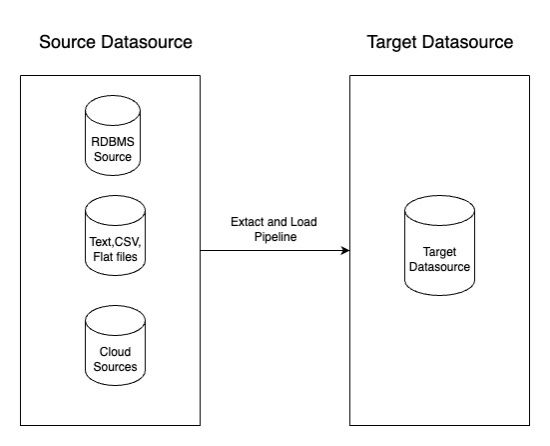
      In this scenario, the target data source of the data pipeline requires transformation jobs that depend on additional IOT device information from a third-party data provider. This dataset changes only a few times in a week and contains fewer than one million rows, making it a relatively slow-evolving entity. However, the challenge is that the data provider does not define a “last updated” or “created at” attribute or any time marker to identify which rows have changed since the last ingestion. This forces user to load the full dataset every time rather than loading just the changed dataset. Given these limitations, the Full Loader pattern becomes an ideal solution. Its simplest implementation follows a two-step Extract and Load (EL) process, where native command exports the entire dataset from the source and import it into the target system. This approach works especially well for homogeneous data stores, as no transformation is required during the transfer. Although it may not always be the most efficient method for large, rapidly changing datasets, it is effective for smaller, slowly evolving datasets ensuring completeness and consistency in the absence of change-tracking attributes. If the source and target data stores are of a similar type — for example, migrating data from PostgreSQL to another PostgreSQL database — intermediate transformations are generally unnecessary because the data structures are already aligned. However, when the source and target systems differ in nature, such as transferring data from a relational database (RDBMS) to a NoSQL database, data transformations are typically required to adjust the schema, format, and structure to fit the target environment.

      Full Loader implementations are typically designed as batch jobs that run on a regular schedule. When the volume of data grows gradually, this approach works well since the compute resources remain relatively stable and predictable. In such cases, the data loading infrastructure can operate reliably for extended periods without performance concerns.However, challenges arise when dealing with datasets that evolve more dynamically. For instance, if the dataset suddenly doubles in size from one day to the next, relying on static compute resources can cause significant slowdowns or even failures due to hardware limitations. To address this variability, organizations can take advantage of auto-scaling capabilities within their data processing layer. Auto-scaling ensures that additional compute resources are allocated automatically during spikes in data volume, maintaining performance and reliability while optimizing resource usage.

      Another important risk associated with the Full Loader pattern is the potential for data consistency issues because the process involves completely overwriting the dataset, a common strategy is to use a truncate and load operation during each run. However, this approach carries significant drawbacks. For example, if the ingestion job executes at the same time as other pipelines or consumers reading the dataset, users may encounter incomplete or missing data while the insert operation is still in progress. To mitigate this, leveraging transactions is the simplest and most effective solution, as they manage data visibility automatically. In cases where the data store does not support transactions, a practical workaround is to use an abstraction layer such as a database view, which allows you to update the underlying structures without exposing incomplete data to consumers.

      In addition to concurrency concerns, there is the risk of losing the ability to revert to a previous dataset version if issues occur after a full overwrite. Without versioning or backups, once the data is replaced, the previous state cannot be recovered. To safeguard against this, it is critical to maintain regular dataset backups or implement versioned storage strategies. This ensures that if unexpected problems arise, the system can roll back to a reliable earlier version, preserving both data integrity and operational continuity